
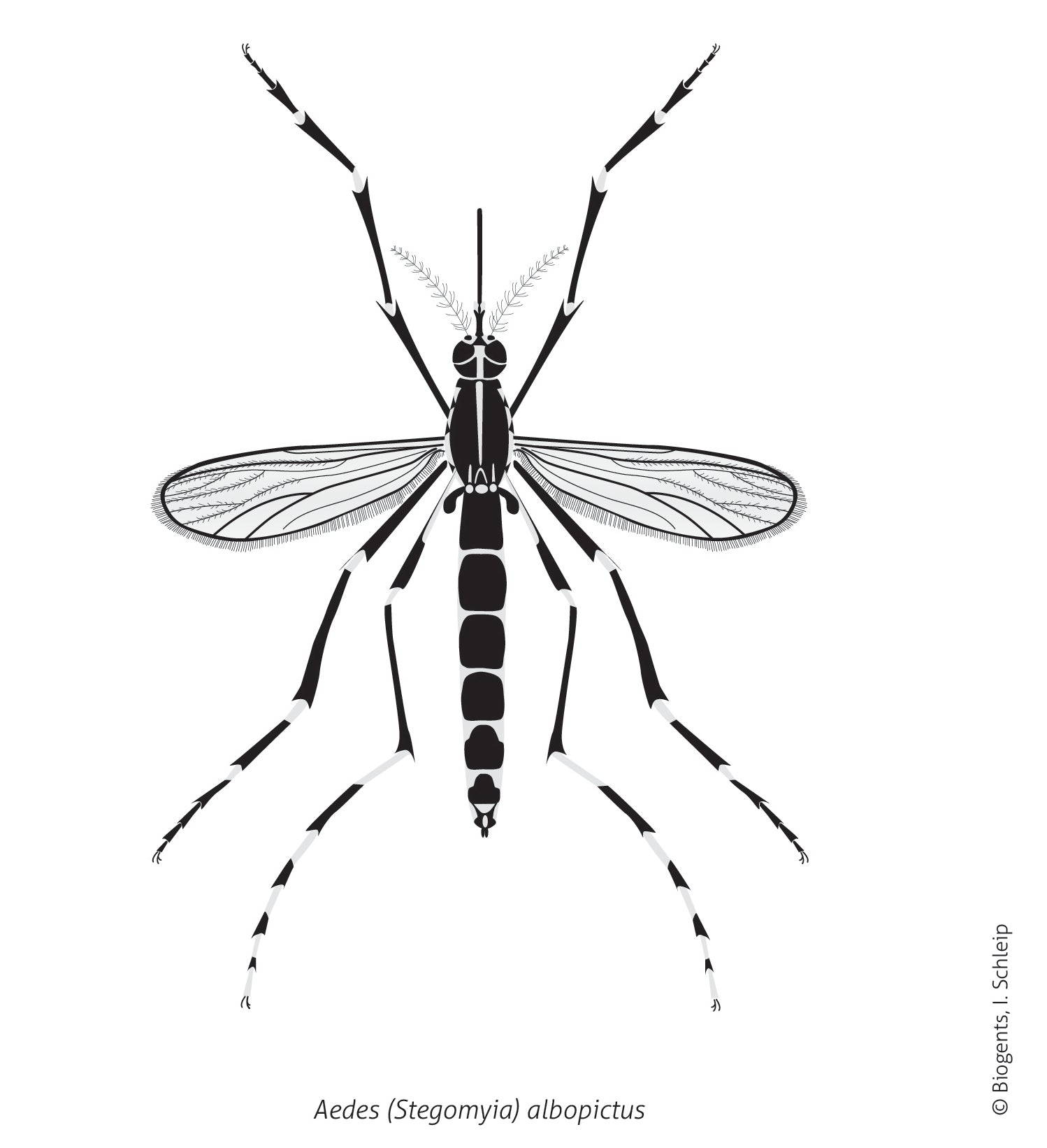
The Asian tiger mosquito (scientifically: Aedes albopictus, meaning “The white-painted unpleasant one”) is a day-active and aggressive mosquito that has been spreading across the United States since the mid-eighties, and it continues to do so.
This mosquito usually lives closely associated with humans in the urban and suburban environment and is a significant nuisance in many communities. It can also be the vector of a number of diseases. Below, you will find a description of the Asian tiger mosquito, its biology, its life cycle and the threat it may pose.
“Albopictus” means white-painted
The Asian tiger mosquito is a small mosquito, with sizes ranging between 1/10 and 1/3 inch. The animal is black with bright white marks (hence albopictus, white-painted). A single white line that begins on the head and continues down the back of the central part of the body (the thorax) is the most conspicuous characteristic, along with the white markings on the legs.
 Asian tiger mosquito (Aedes albopictus)
From dawn to dusk
Unlike other nuisance mosquitoes, the Asian tiger mosquito is primarily active during the day, including dawn and dusk. In many communities, it has become the major pest mosquito and, due to its unusually aggressive biting, has taken the joy out of spending time in the yard and garden. Adult tiger mosquitoes tend to rest near the ground in vegetation and readily bite if disturbed.
Although Aedes albopictus is usually an outdoor biting mosquito, it has also been collected biting indoors. It is fairly common for tiger mosquitoes to follow people indoors when doors are left open. The mosquito flies close to the ground and does not fly in strong winds. It tends to have a short flight range and remains within a few hundred meters of their larval habitats.
Distribution in the United States
The Asian tiger mosquito is a traveler, but a lazy one – so it hitchhikes. Around the world it is mainly the eggs and larvae that are transported in shipments of lucky bamboo, flowers, or also in used car tires. Once established in a certain area, the adult female mosquito follows its human hosts into cars, buses, trucks and trains. New populations can therefore be found along highways, in service and resting areas, and around bus and train terminals.
Since it was first detected in the United States in 1985 (that was in Houston, TX), the Asian tiger mosquito has spread to more than 1,350 counties in 40 states and the District of Columbia. It is now one of the major mosquito pest species throughout most of the southcentral and eastern United States.
 Distribution of the Asian tiger mosquito in the US (CDC, Hahn et al. 2017)
Counties with black dots had new, previously unreported surveillance records in 2016. The map indicates presence, not abundance, and does not indicate risk levels for any specific disease.
Distribution of the Asian tiger mosquito in the US (CDC, Hahn et al. 2017)
Counties with black dots had new, previously unreported surveillance records in 2016. The map indicates presence, not abundance, and does not indicate risk levels for any specific disease.
 Estimated potential range of the Asian tiger mosquito in the United States (CDC 2017)
The map predicts the likelihood that Aedes albopictus can survive and reproduce in a given region.
Estimated potential range of the Asian tiger mosquito in the United States (CDC 2017)
The map predicts the likelihood that Aedes albopictus can survive and reproduce in a given region.
Small quantities of water are enough for reproduction
In its native range in Asia, Ae. albopictus was originally a treehole mosquito, and inhabited densely vegetated rural areas. However, it developed a great adaptability in colonizing new habitats in urban and suburban areas. Females utilize flower pots, bird baths, soda cans, buckets, plant saucers, plastic drainpipe extensions and many other human-made water holding containers as sites to deposit eggs. Tires are particularly useful for mosquito reproduction as they are often stored outdoors and effectively collect and retain rain water for a long time.
Eggs, which can resist drying out, are deposited above the water line in containers subject to flooding. When eggs are covered by water, the larvae hatch and begin a development in four stages. Larvae feed primarily on organic material that they filter out of the water with their mouthparts. They can be commonly observed hanging at the surface of the water where they breathe through a snorkel-like siphon at the end of the body (the abdomen). The length of time required to complete larval development depends upon temperature and availability of food, and is typically completed between 6 and 10 days during the summer months in the US.
At the completion of larval development, the fourth-stage larva molts into the pupal stage. Pupae can be observed tumbling in the water hanging at the surface where they breathe through two snorkel-like trumpets at the front end. The pupal stage usually lasts a few days and then the adult mosquito emerges and seeks a resting site in low vegetation.
Adult mosquitoes of both sexes feed on sweet plant juices and nectar to meet their energy requirements. Mating takes place 2 to 3 days after adult emergence and females take their first bloodmeal shortly afterwards. Only female mosquitoes feed on blood, which they require to provide protein for egg production. A female produces 50 to 150 eggs per oviposition. There are 1 to 4 egg laying cycles over the course of a female’s lifetime.
In the more northern parts of its US distribution, the tiger mosquito has the ability to sense shorter day lengths towards the end of the summer and lay eggs capable of undergoing developmental arrest (diapause) in order to survive cold winter temperatures.
What diseases does the Asian tiger mosquito transmit?
Asian tiger mosquitoes have been shown to be susceptible to infection with at least 32 viruses, including 13 that are present in the United States, as well as the parasite that causes heartworm in dogs. The most important viruses transmitted by Ae. albopictus include dengue, chikungunya and Zika.
The role of Ae. albopictus as a vector for dengue is well documented and it has been responsible for the transmission of dengue virus in regions where Ae. aegypti is absent or only present in low populations (such as Hawaii). Because the Asian tiger mosquito feeds on a variety of other animals besides humans, scientists also consider it a potential “bridge vector”, meaning that it may pick up disease agents from animals, and then transmit them to humans. In the United States, its role as a bridge vector is recognized for the West Nile virus (WNV) and eastern equine encephalitis virus (EEEV). Besides WNV and EEEV, Aedes albopictus has also been shown to be a good vector of LaCrosse encephalitis.
Control mosquitoes without insecticides
For a persistent control, Biogents mosquito traps can help to reduce the local mosquito population on a long-term basis. For outdoor use: BG-Mosquitaire, BG-GAT, or BG-Mosquitaire CO2. With the BG-Home for indoors you can complement the control system. Further measures: elimination of breeding sites.
See All Traps →
Share:
Eastern Equine Encephalitis (EEE)
Yellow Fever Mosquitoes (Aedes aegypti)