
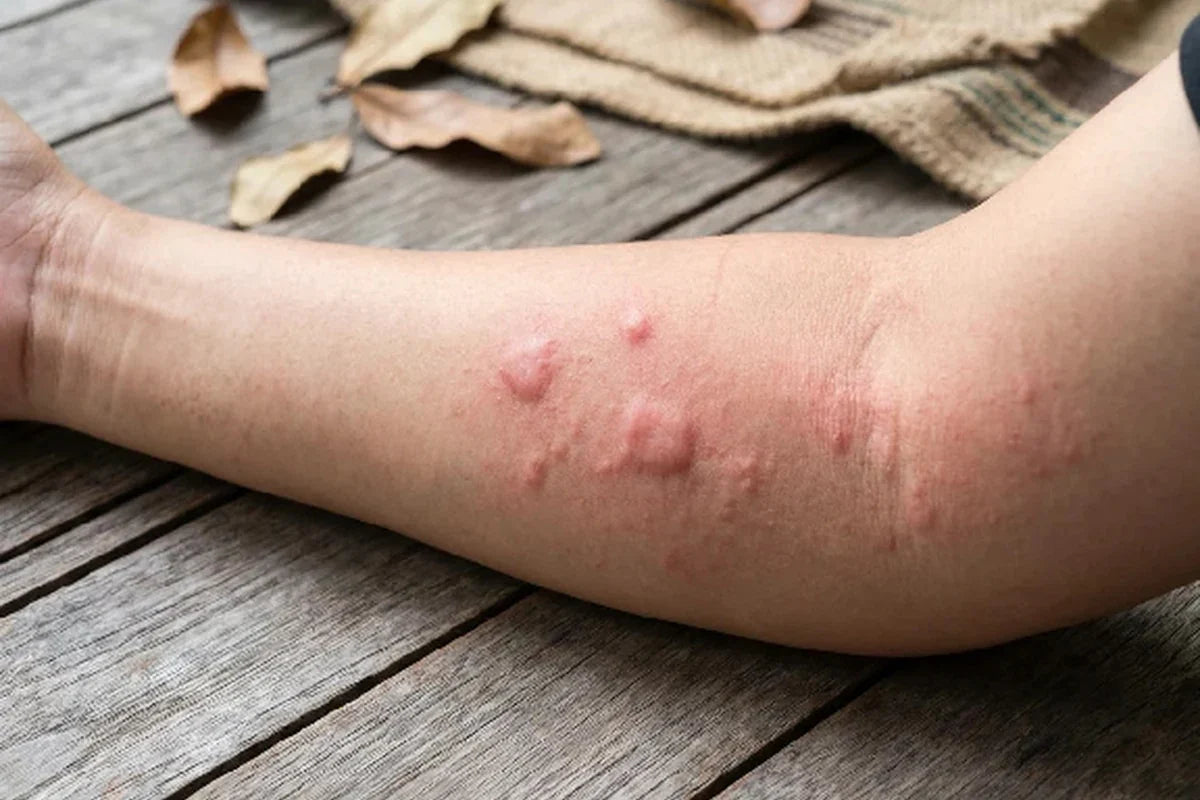
Hives move. Mosquito bites don't. That one difference settles most cases, and you can check it yourself in a couple of hours.
A hive is a raised welt that comes up, fades, and reappears somewhere else entirely. Draw a pen line around one and come back later, and you'll often find it's gone and new welts have appeared elsewhere. A mosquito bite stays put until it heals, and most have a small puncture point in the middle. If the marks are moving around, your body is reacting to something rather than anything having bitten you.
Key Differences in Appearance and Timing
A mosquito bite comes up as a puffy, reddish bump within minutes, because your immune system is reacting to the saliva. By the next day that soft swelling often firms into a reddish-brown bump, and it stays visible for several days after that.
Hives are raised, itchy welts with clearly defined edges, and they can come up in clusters anywhere on your body. They change shape as you watch them, growing and merging into plaques (larger raised patches where several welts have run together). Any one welt rarely lasts more than a day or two in the same spot, and it usually fades while new ones are coming up nearby.

Evaluating Location and Triggers on the Body
Mosquitoes can only bite skin that's uncovered, so bites tend to concentrate on ankles, wrists, necks, and bare arms after time outside. If yours are gathered tightly around the lower legs instead, read flea bites vs. mosquito bites, since fleas work their way up from the floor.
Hives don't need bare skin at all. Because they come from a systemic reaction (one affecting your whole body rather than the spot something touched), they appear under clothing, across your torso, and down your back just as readily. Common triggers include foods, medications, a viral infection you're getting over, heat, stress, and friction from tight clothing. So if you wake up covered in welts on skin that was under pyjamas all night, stop looking for an insect and start thinking about what you ate, took, or caught.
The puncture mark is the other thing to look for. A mosquito bite usually has a tiny pinpoint centre where the mouthparts went in, and hives never do. If you find a single mark with an obvious centre and it's more painful than itchy, read spider bites vs. mosquito bites before assuming a mosquito.

When Mosquito Bites Cause Allergic Hives
The two aren't always separate, which is the part that catches people out. Some people react strongly to the proteins in mosquito saliva, and for them a single bite can produce large, swollen welts spreading well past the bite itself. It has a name, skeeter syndrome, and it's a local inflammatory reaction rather than a true allergy.
You'll see heavy swelling, redness, warmth, and sometimes a hard, painful lump. It usually starts eight to ten hours after the bite and settles within three to ten days. It's most common in young children, whose immune systems haven't yet become desensitised to mosquito saliva, and different mosquito species carry different proteins, so you can react badly to one species and barely at all to another. If the swelling came up overnight and you can't account for it, bed bug bites vs. mosquito bites covers what else produces marks while you sleep.
Whatever caused them, hives can be the first sign of something more serious. Go straight to emergency care if they come with difficulty breathing, throat tightness, wheezing, dizziness, or swelling of your face, lips, or tongue. That combination means the reaction has gone systemic and it needs treating urgently.

How to Investigate Welts and Bites at Home
If new bumps have appeared and you can't place them, these four checks take a few hours and will usually tell you which you're dealing with.
- Draw around them. Take a skin-safe pen and outline two or three of the welts, then check them again in a few hours. Hives will have faded, changed shape, or moved somewhere else entirely. Mosquito bites will still be sitting inside the lines you drew.
- Do a blanch test. Press a clean finger on the centre of a welt for about three seconds and let go. Hives usually go white under the pressure and flush back to red almost immediately. A mosquito bite mostly keeps its colour.
- Look for a puncture point. Under a good light, check the centre of each mark for a tiny pinprick or a small crust. That means something pierced the skin, so you're looking at a bite. Hives have no puncture point at all.
- Work out what changed. If the answer is bites, check the yard for standing water and shaded planting where mosquitoes rest. If the answer is hives, think back over the last day or two for a new food, a new medication, an infection you're shaking off, or anything your skin was in prolonged contact with.
Targeting the Outdoor Mosquito Population
If the checks point to bites rather than hives, the job is outdoors. Start by emptying standing water, since that's where mosquitoes breed, then deal with the ones already flying.
A Mosquitaire trap imitates the warmth and scent of a person, so put it in the damp shaded planting where mosquitoes rest during the day and keep it well away from where you sit. If you're being bitten at dusk or after heavy rain, those species hunt by carbon dioxide, so a CO2 trap is the upgrade that works best in this scenario.
The GAT works on a different stage altogether. Rather than pulling in mosquitoes that are hunting you, it offers them the thing they're looking for after they've already fed, which is dark, still water to lay eggs in. They go in, and a sticky card inside catches them. There's no power and no insecticide involved, so it's a trap you can leave in a planted corner and largely forget about. You can compare it against the full range if you're unsure.

Frequently asked questions
Can the Absence of a Puncture Mark Rule Out a Mosquito Bite?
No. A puncture point is good evidence that something bit you, but not finding one proves less than you'd think, because they're small and easy to miss once a bite has swollen. Go by whether the mark stays put instead, since that's the more reliable test.
What if One Mosquito Bite Becomes Unusually Large or Painful?
That's usually skeeter syndrome, a large local reaction to mosquito saliva that produces heavy swelling, redness, and sometimes a hard, painful lump. It typically settles within three to ten days. See a doctor if it keeps spreading, stays painful, or starts looking infected.
Should I Use a Mosquito Trap While I Am Still Seeing New Welts?
A trap will reduce the mosquitoes around your yard, which is useful if mosquitoes are the problem. It won't tell you what's causing welts and it won't do anything for hives. If new welts keep appearing and you can't account for them, that's a question for a doctor rather than a trap.
Can Hives and Mosquito Bites Happen at the Same Time?
Yes, and that's the case that confuses people most. A bite can set off hives elsewhere on your body, so you can end up with a fixed, punctured bite on your ankle and moving welts on your back at the same time. Treat the two separately, deal with the mosquitoes outside, and talk to a doctor about the hives.
Share:
Spider vs Mosquito Bite: Symptoms, Timing, and Safe Care
Spider vs Mosquito Bite: Symptoms, Timing, and Safe Care