
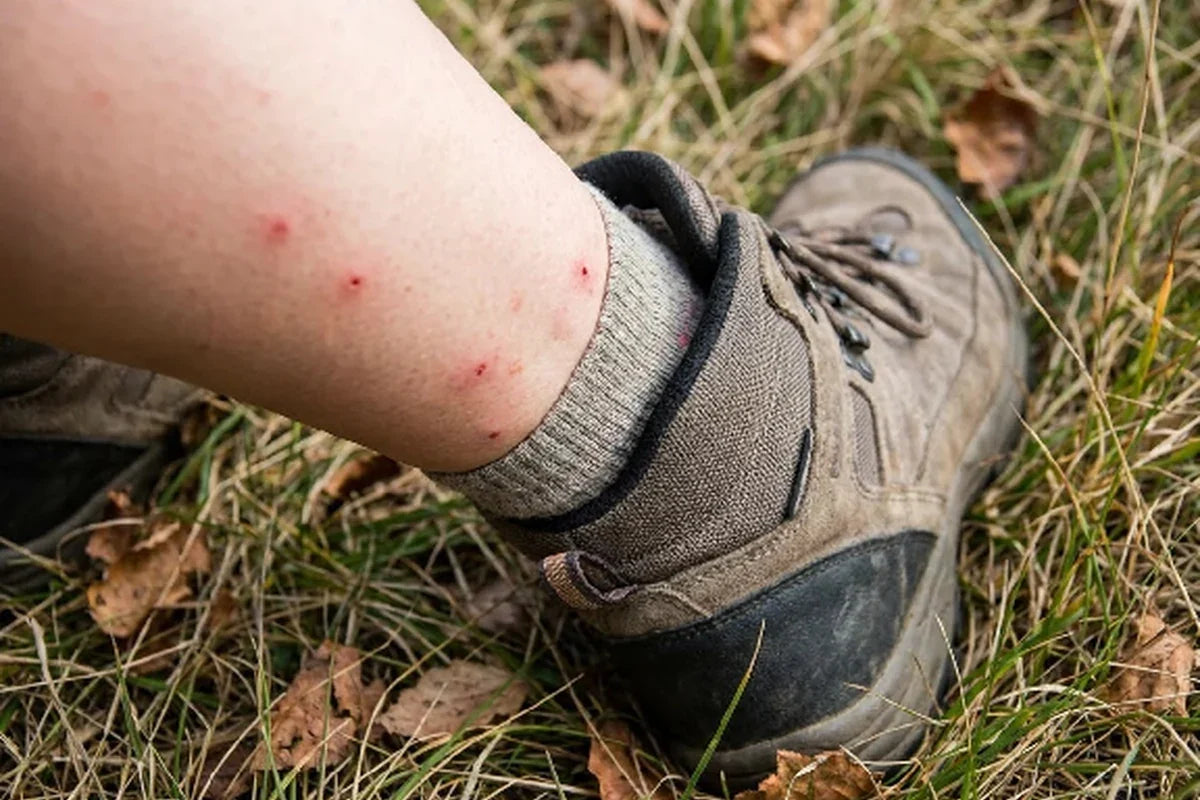
You can't tell a bed bug bite from a mosquito bite by looking at it. Both leave a red, itchy bump, and that bump is your own immune reaction to insect saliva rather than a signature of the insect that bit you.
What does tell them apart is timing. You'll usually feel a mosquito bite swell within minutes of being outside. A bed bug bite often won't show for days, and for some people as long as two weeks.
So before you buy anything to treat the problem, work out which insect you're dealing with. Track when new marks turn up, check your bedroom for signs of bed bugs, and check your yard for standing water and shaded resting spots. If you treat the wrong pest, you'll spend the money and still get bitten.
How Bite Patterns and Reactions Differ
A mosquito injects saliva while it feeds, and your body reacts to the proteins in it. That reaction is the bump you see, not the bite itself. Most people get a puffy red mark within minutes, and a day later it can firm up into a reddish-brown lump that itches.
Not everyone reacts the same way. Some people get small blisters instead, or dark marks that look like bruises. A stronger reaction can bring swelling well past the bite itself, along with soreness, hives, a mild fever, or swollen glands. Most of the time you'll feel the pinch or notice the swelling before you've even gone back inside.
Bed bugs work differently, and the difference is what makes them hard to catch. They feed while you're asleep, and their saliva numbs the skin as they go, so you won't feel a thing at the time. Your immune system is also slower to react to bed bug saliva than it is to mosquito saliva.
Put those two things together and the timing stops matching your memory. Marks can appear days after the night you were bitten, and for some people as long as two weeks later. Other people never come out in anything at all. When the marks do show, they're slightly swollen red patches that itch, often in a line or a tight cluster of three or four.
So everyone reacts differently, which is exactly why the mark itself won't settle the question for you. The same problem comes up with other biting pests, so rule those out before you commit to a treatment.
Bites clustered around your ankles after an evening with the dog raise a different question, and our guide to flea bites vs mosquito bites covers what to check on the pet. Welts along a waistband or sock line after a walk through long grass point instead at chigger bites vs mosquito bites. And if welts keep appearing with no insect anywhere and no puncture mark, compare them against hives vs mosquito bites before you treat for a pest at all.

Four Steps to Identify the Source
- Keep a bite log for three to five days. Every time you find a new welt, write down the date, where it is on your body, and where you'd been in the day beforehand. Three days is usually enough to see a pattern, and five is better if the bites are coming irregularly. The pattern is what you're after, not any single mark. If they're turning up on your ankles and legs after you've been working outside, look at the yard. If you keep finding them on your neck, arms, or face when you wake up, look at the bed.
- Search the bed itself. Strip the sheets back, take a bright flashlight, and work slowly along the places bed bugs hide: mattress seams and piping, the headboard, the frame joints, and the crevices where the baseboard meets the floor. You're looking for four things: live insects, which are flat and brown, shed skins, pale eggs, and small dark spots of droppings on the fabric. Any one of those settles the question in a way that a bite on your arm never will. If you find nothing on the first pass, check again after a few days rather than ruling bed bugs out.
- Walk the yard. Start by tipping out standing water wherever you find it, in plant saucers, gutters, buckets, and anything else holding rain, because that's where mosquitoes breed. Then look for the places they rest during the heat of the day. Those spots are under dense shrubs, beneath a deck, along a hedge line, in the shaded corners of the patio. Damp, planted, sheltered pockets like these are the hotspots in your yard, and they're where the mosquitoes sit waiting. If you find them resting there, you've answered your question.
- Treat the itch while you work it out. Wash your skin gently with mild soap and water, then use an anti-itch cream such as hydrocortisone to take the edge off. Try not to scratch, however much you want to, because broken skin lets bacteria in. Keep an eye on anything you have scratched. If the redness starts spreading outward, the area feels hot to the touch, or you see red streaks running away from the bite, see a doctor. Those are signs of infection rather than a bad reaction.

Choosing the Right Intervention for Your Yard or Home
Don't put a mosquito trap in a bedroom to deal with a suspected bed bug problem. Our traps catch flying insects that are hunting for a blood meal. They can't do anything about a crawling insect living in a box spring, a furniture joint, or under a floorboard. You'd be running equipment against the wrong pest and still waking up bitten.
If you find bed bugs, you need someone who treats bed bugs indoors, and that's a different trade from anything you'd do in the yard. A bed bug infestation lives in the seams, joints, and cavities of your furniture, so it gets solved by heat treatment, targeted indoor products, and a thorough enough search to find every hiding place. Nothing you apply outside will touch it, however carefully you use it, and an outdoor product used indoors isn't labelled for that and won't work anyway. Book a pest control specialist, and tell them what you found and where you found it, because that shortens their inspection.
If the evidence points outside instead, start with the water. Empty the saucers, buckets, and gutters where mosquitoes breed, because a trap won't keep up with a yard that's producing new mosquitoes every week. Our range of mosquito traps works alongside that, not instead of it.
Then put a trap where the mosquitoes actually are. A Mosquitaire mosquito trap works by imitating the things that draw a mosquito to a person in the first place: the warmth rising off your skin and the scent your body gives off. Site it in one of the shady, planted hotspots you found when you walked the yard, and keep it well away from where you actually sit, at least fifteen feet.
That distance matters more than people expect. Put the trap next to your patio chairs and it pulls mosquitoes toward you. Put it between the hotspot and your seating and it intercepts them on the way. Leave it running continuously through the season rather than switching it on for an evening, because you're reducing the population over weeks, not clearing the air tonight.

Practical Expectations and Long-Term Relief
A trap works by reducing the mosquito population around your yard over weeks, so run it continuously rather than switching it on when you want to sit outside. Each mosquito it catches is one that doesn't go on to lay eggs, and that's where the real reduction comes from. Turn the trap off between uses and the population you removed simply builds back.
Check the catch net once a week. You're confirming two things: that the trap is still running properly, and that what's in the net is actually mosquitoes. Most people see a noticeable drop in biting over two to four weeks of steady use.
Keep on top of the water as well, because a trap can't outpace a yard that's breeding new mosquitoes every week. Walk the yard again after heavy rain and tip out whatever has filled up. Between the two, you're catching the adults that are biting you now and preventing the ones that would bite you next month.
Frequently asked questions
Can bed bugs be present if no one has visible bites?
Yes. Some people never come out in a visible reaction at all, so an absence of bites tells you nothing either way. Check the bed itself instead, along the mattress seams and the frame joints, and look for live bugs, shed skins, eggs, dark spotting, or rusty stains on the sheets.
Can I work out when I was bitten from when the rash appeared?
No. Bed bug marks can take up to 14 days to show, so the day you notice them tells you very little about the night you were bitten. This matters most after travel, because a rash that appears at home may well date back to a hotel stay.
When should I see a doctor about a bite?
Go to emergency care straight away for difficulty breathing, throat tightness, or severe swelling, since those point to a serious allergic reaction. Book a normal appointment if you develop a fever, or if the area around a bite is spreading, hot to the touch, or growing a red streak, which suggests the skin has become infected.
Can a mosquito trap confirm that mosquitoes caused the bites?
No. A catch tells you that mosquitoes are active where the trap is running, which is useful, but it can't tell you what caused any particular mark on your skin. That's the same limit as everywhere else in this article: the physical evidence you find tells you what's in your house or yard, not what bit you on Tuesday.
Share:
All Natural Mosquito Control Treatment: A Practical Yard Plan
All Natural Mosquito Control Treatment: A Practical Yard Plan