
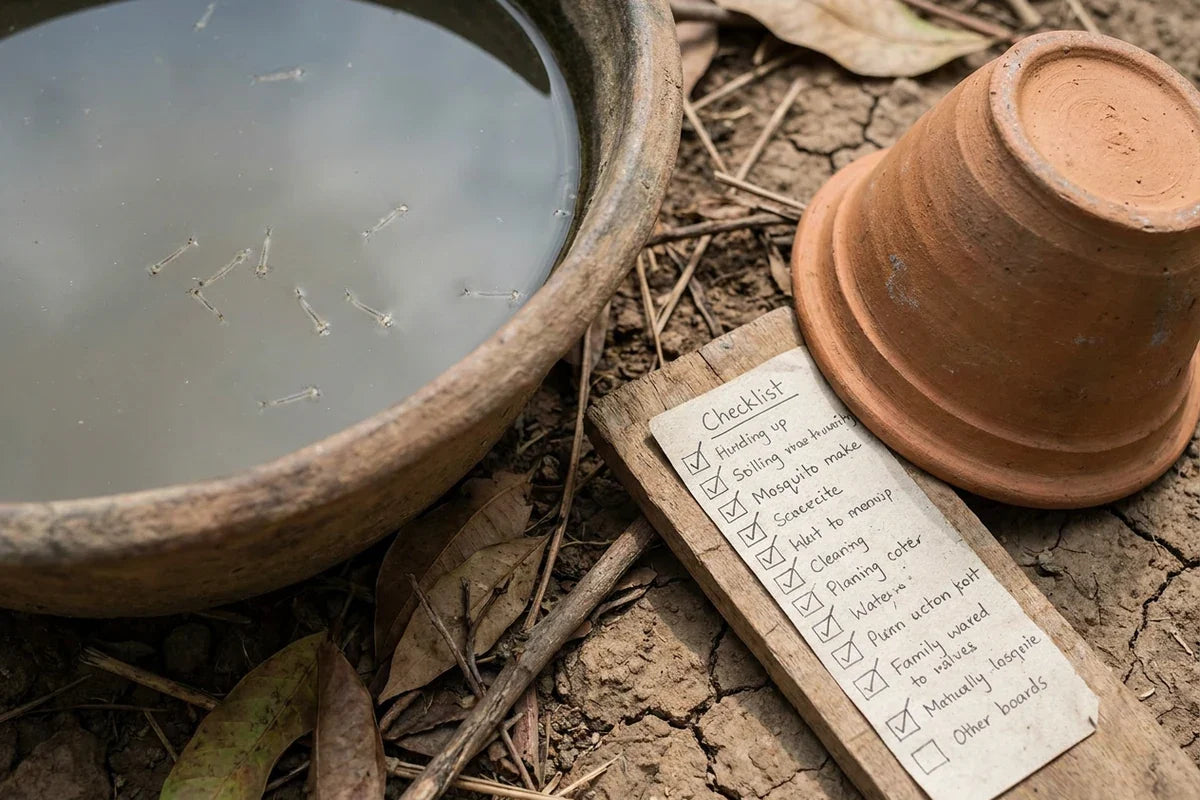
To kill mosquito larvae in water, remove the water and clean the container whenever you can. If the water must remain, treat it with an EPA-registered larvicide that is labeled for that setting. Skip improvised household mixtures, and never add more than the product label allows.
Remove the Water and Attached Eggs
Start with the container, not the larvae. Mosquitoes can lay eggs in a small amount of water, and some eggs remain attached to the container walls after the water is poured out. A regular cleanup removes the current habitat and helps prevent another group of larvae from appearing in the same place.
- Empty and drain items that can be moved, including buckets, small containers, and pool covers. Tip them far enough that water does not remain in a rim, fold, or low spot.
- Scrub the inside walls to loosen mosquito eggs that may remain above or near the waterline. Pay attention to the line left by the previous water level rather than rinsing only the bottom.
- Turn empty items upside down or cover them so they cannot refill. A container that fills again after rain can put you back at the same starting point.
- Discard water-holding objects you no longer need, especially items such as old tires. Removing the object also removes one more container from your weekly check.
Repeat this check at least once a week. The CDC’s container cleanup advice includes emptying, scrubbing, turning over, covering, or throwing away anything that holds water. That combination matters because pouring out the water without cleaning the sides can leave eggs behind.
A simple route around your property makes the weekly check easier to maintain. Look at the places where water collects after rain, then check containers that are easy to overlook because they are partly hidden or normally stay dry. Buckets beside a shed, a sagging pool cover, and an unused tire are more useful examples than a long inventory of everything outdoors. Once you find a repeat problem, empty it and change how it is stored so it does not demand the same cleanup next week.
Not every small moving shape in a container is equally easy to recognize. The complete guide to mosquito larvae in water covers the subject in more detail.

Treat Water That Has to Stay
Some standing water cannot be emptied or covered. Rain barrels, non-chlorinated pools, and water trapped in gutters are common examples. In those situations, use a registered larvicide only when the water will not be used for drinking and the label specifically permits treatment there.
Bti (<i>Bacillus thuringiensis</i> subspecies <i>israelensis</i>) is a biological larvicide. Mosquito larvae die after eating it, which stops them before they complete their development. It is sold in several forms, including dunks, tablets, briquettes, pellets, granules, and liquids. Bti does not kill biting adult mosquitoes. The CDC’s explanation of Bti provides more detail on how this larvicide affects the feeding stage.
| Larvicide Type | What It Does | When to Use It |
|---|---|---|
| Bti | Kills larvae when they consume it | For eligible standing water where the product label allows treatment |
| Methoprene or pyriproxyfen | Prevents larvae from completing development | When an EPA-registered product is labeled for the specific container or water setting |
| Oils and surface films | Interfere with breathing at the water’s surface | For use by licensed mosquito-control professionals |
The product form tells you how the treatment is supplied, but it does not tell you whether that treatment belongs in your particular container. A dunk labeled for one type or volume of standing water is not automatically interchangeable with a liquid or a handful of granules. Check the permitted setting and measurement instructions before opening the package. This is especially important when a container holds much less water than it appears to hold or its water level changes between rainstorms.
Read the entire water-treatment label before measuring or applying anything. EPA-registered larvicides have been evaluated for effectiveness and safety, and the directions tell you where the product may be used, how much to apply, and when another application is permitted. According to the CDC’s larvicide guidance, these products do not harm people, pets, or the environment when used according to the label.
Keep the package available after treatment rather than relying on memory for the next application. The allowed timing, amount, and water setting belong together. If the label does not name your intended use, choose a product that does instead of trying to adapt the directions yourself.

Do Not Substitute Household Chemicals
A bottle under the kitchen sink is not a stand-in for a labeled water treatment. Household chemicals may have no directions for mosquito control in standing water, leaving you without an approved dose, application method, or suitable-water instruction. Adding a stronger mixture does not fix that problem.
If you are considering common DIY suggestions, check the guide to whether vinegar kills mosquito larvae and the guide to whether bleach kills mosquito larvae before putting anything into the water. The safer practical choice is still straightforward: remove the water or choose a registered product whose label matches the setting.
The missing label information is the real problem with a homemade approach. You need to know whether a substance is approved for the type of water in front of you, how it should be measured, and when it can be used again. A familiar household product does not answer those questions simply because it is already in your home.
Product form also needs to fit the container and its label. A dunk, granule, or liquid is not automatically suitable for every rain barrel, fountain, or pool cover. The guide to choosing a mosquito larvae killer can help you sort through the available treatment categories without guessing at the dose.

Address Adult Mosquitoes Separately
Larval treatment deals with mosquitoes while they are still developing in water. It will not remove adult mosquitoes that are already flying and biting. When both stages are present, keep the jobs separate rather than expecting one method to handle everything.
That separation also makes it easier to choose the right tool. Water cleanup removes available breeding sites, and labeled larvicides address eligible water that has to remain. Traps belong on the adult side of the plan. They complement the work around containers instead of replacing it, so continue managing standing water even when an adult trap is operating nearby.
You can compare options for trapping adult mosquitoes alongside your water-management routine. For mosquitoes looking for places to lay eggs, consider traps designed around gravid females. Another route is a suction-trap setup for outdoor spaces. This lets each part of the plan focus on the mosquito stage it is intended to address.
Frequently asked questions
Can I Put Mosquito Larvicide in Drinking Water?
No. Household larvicides should be used only in standing water that will not be used for drinking and only where the product label permits treatment.
Will Bti Kill Mosquito Pupae?
It may not. Bti works when feeding larvae eat it, but mosquito pupae do not eat. Oils and surface films used to kill pupae are professional mosquito-control treatments.
How Often Should I Reapply a Larvicide?
Follow the reapplication instructions on the product label. Do not add extra product or use a guessed schedule, even if larvae remain visible.
Can I Use Larvicide in a Decorative Fountain?
A fountain may be treated if its water is not used for drinking, it cannot reasonably be emptied or covered, and the larvicide label specifically permits that use.
Share:
How to Get Rid of Mosquitos Outside With Better Yard Control
Mosquito in House: Where It Hides and How to Keep It Out