
Not all mosquitoes behave the same way, and that's usually why a setup that worked for your neighbor does nothing for you. The ones biting you at three in the afternoon are a different species from the ones biting you at dusk, they breed in different places, and they find you by different means.
So the useful first question isn't which trap to buy. It's which mosquitoes you have, because once you know that, you know where to look for the water, where they're resting, and what will actually catch them.
Matching Traps to Mosquito Behavior and Species
Which mosquitoes you have depends on where you live, but two species turn up in most US backyards and they behave differently enough that you can usually tell them apart by when you're bitten. Asian tiger mosquitoes bite through the afternoon, and they find you mostly by sight and by the smell of your skin, so dark clothing and a shaded patio work in their favor. House mosquitoes come out around dusk and follow the carbon dioxide in your breath instead.
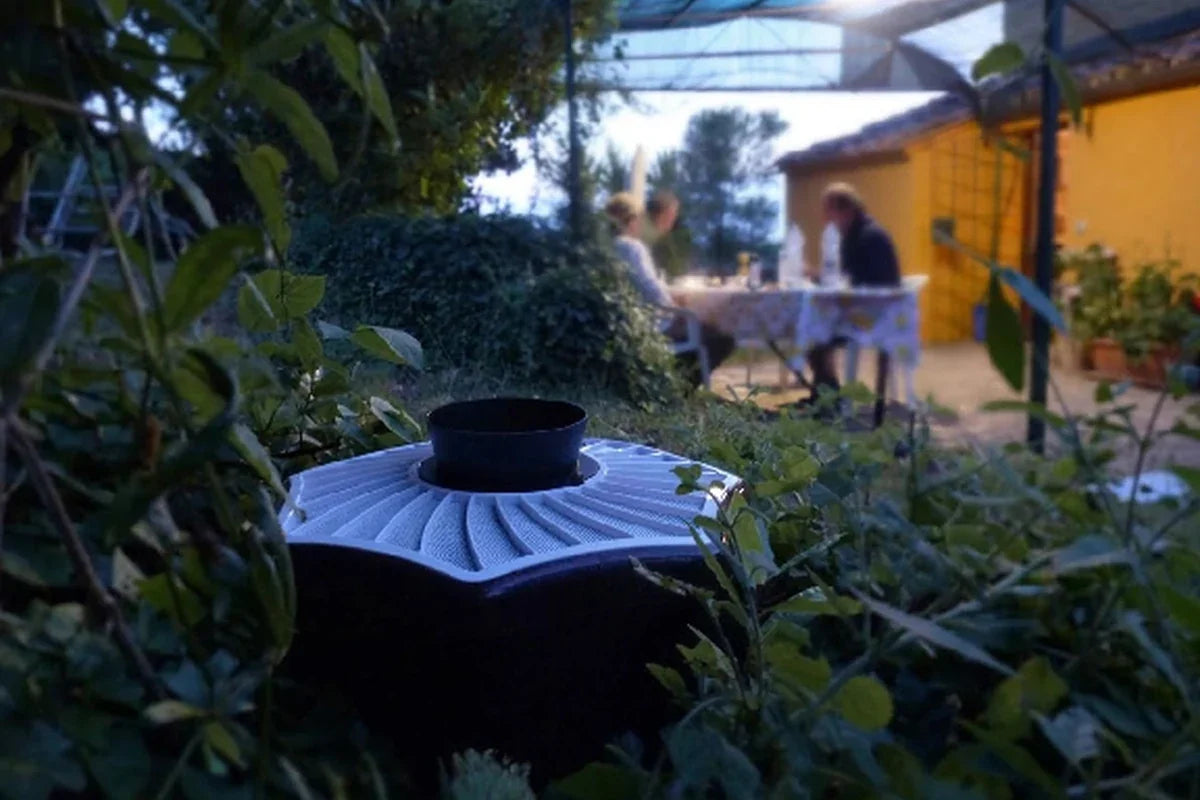
That's why a trap that works on tiger mosquitoes is built the way it is. The black and white pattern gives them the high-contrast shape they're looking for, and the warm air rising off the top imitates the convection current coming off a person standing in the yard. Between those and the skin-scent lure, it presents as a person from a few yards away.
That design came out of a research lab rather than a product meeting. Biogents started by building traps for scientists who needed to catch mosquitoes alive and in numbers, which meant working out what actually draws a mosquito to a person and then reproducing it. The traps sold for backyards are the same ones, scaled for a patio instead of a field study.
House mosquitoes need something else, because sight and skin scent aren't what they're following. Adding a CO2 cylinder to the trap puts out a steady stream of carbon dioxide, which imitates someone breathing, and that brings in the dusk species along with everything the trap was already catching. Our guide to the best residential mosquito control covers how to match that to your yard's layout.
None of this stops at the back door. Tiger mosquitoes come indoors quite happily and will bite you in the afternoon in your own living room, and house mosquitoes come in too, then spend the day resting somewhere dark and still until it gets dark. People often assume that's a separate problem when it's the same mosquitoes following the same cues.
Where they're coming through is usually a covered patio, a garage, a screened porch or a workshop, and the Home trap is built for exactly those spaces. It works best somewhere that isn't air conditioned, since the attractant needs still air to spread properly.

Diagnosing Yard Conditions and Moisture Hotspots
Once you have some idea what you're dealing with, go and look for where they're living. Mosquitoes dry out fast, so they spend the day somewhere humid and shaded, which in most yards means under a low deck, in dense groundcover, in deep ivy, or along a shrubbery border.
Pay attention to the wind as well. Mosquitoes are poor fliers in moving air, so they work their way toward you along sheltered routes, down the side of a hedge or between the house and the fence. Those routes are where a trap will do the most good, because you're catching them on the way in rather than once they've arrived.
Then look for the water, using what you already know about which mosquitoes you have. Tiger mosquitoes breed in small containers close to the house, so that's the plant saucers, the toys, the buckets, and the corrugated downspout extensions that hold water for weeks without anyone noticing. House mosquitoes prefer standing water that's been sitting long enough to go stagnant, which means the clogged gutter, the neglected birdbath, or the rain barrel nobody has opened since spring.
Either way, empty, scrub, turn over, cover, or discard anything holding water at least once a week. Scrubbing is the part people skip, and it's what removes the eggs stuck to the sides above the waterline.
Some water can't be drained at all, like a drainage swale, a retention pond, or a permanent water feature. For those, a Bti larvicide kills mosquito larvae and leaves other wildlife alone, and the EPA's position is that it poses no risk to people when used as the label says. Check that label before you treat any water that animals drink from, since the rules differ between products.

Setting Up Your Continuous Yard System
Placing the trap is the part people get wrong, and it's understandable. You want it somewhere you'll remember to check it and can get to easily, which usually means near the patio or by the back door. That works against what it's there to do, because the spots that are convenient for you are sunny, open and breezy, and those are exactly the conditions mosquitoes avoid, since moving air makes flying hard work and sun dries them out.
Put a Mosquitaire in the shaded damp planting you identified earlier, on one of those sheltered routes if you can, and at least fifteen feet back from where you sit. Too close and you're competing with it, since you're the real version of what it's imitating.
Add a GAT in a quiet corner if container breeding is your problem, which it usually is with tiger mosquitoes. It's passive and needs no power, and it catches them when they're looking for somewhere to lay rather than when they're looking for you.
Leave the trap running continuously through the season. This is where knowing your species pays off again, because a trap switched on for the evening misses the tiger mosquitoes entirely, and they're the ones biting you at lunchtime. Since it'll be outside and powered for months, keep the connection off the ground and clear of sprinklers, and plug it into a GFCI outlet, the kind with the test and reset buttons that cuts the power if water gets in. Unplug it at the outlet before you handle it for any reason, and especially after rain.
If you're weighing this against a spray service, our guide to residential mosquito spraying goes through what a treatment costs, how long it lasts, and where it fits.

Maintaining Trapping Gear for Continuous Protection
Upkeep is light but it isn't optional. Empty the catch bag every week or two depending on how much you're catching, and clear leaves, clippings and cobwebs out of the intake while you're there. Replace the scent lure every two months, because it fades rather than stopping outright and you won't notice from looking at the trap.
After a storm, check that it's running again before you draw any conclusions. A trap that's been off for three days will have an empty catch bag, and that looks exactly like a trap in the wrong place. If the catch drops off while you're still being bitten, try a different location rather than buying a second trap, keeping it at the edge of the planting rather than pushed into it. You can compare the full range of traps if you do decide you need more coverage.
Frequently asked questions
How Many Traps Should a Residential Yard Use?
There's no fixed number, and it depends on the yard rather than its size. Start with one, put it on the sheltered route between where they're resting and where you sit, and give it a couple of weeks. If you're still being bitten in a part of the yard the trap isn't covering, that's your second location rather than a sign the first one failed.<br><br>How much pressure you're under comes into it as well. A property backing onto wetland, a creek or a wooded lot has mosquitoes arriving constantly from outside, and so does one where the neighbors aren't dealing with their own standing water. Two identical yards can need quite different setups for that reason alone.
What if Mosquitoes Are Biting Indoors?
It's often the same mosquitoes rather than a different problem, and it isn't only one species. Tiger mosquitoes follow you inside and carry on biting in the afternoon. House mosquitoes come in too and then spend the day resting somewhere dark and still, in the folds of a curtain or behind furniture, which is why you find one on you at two in the morning.<br><br>Check the screens and the gaps around doors, then check indoors for water, because the saucer under a houseplant is as good a breeding site as anything outside and nobody empties it. If they're still getting in after that, the <a href="https://us-shop.biogents.com/products/bg-home-indoor-trap-against-tiger-mosquitoes">Home trap</a> is made for the covered patio, garage or porch they're coming through, and it works best in a space that isn't air conditioned.
Can Bti Be Used in Every Water Container?
No. The labels differ between Bti products, particularly about water that animals drink from, so read the one on the package in front of you rather than assuming all Bti products are approved for the same uses. Use an EPA-registered product and follow what its label says.
What Should I Check After a Storm Interrupts a Trap?
Unplug it before you touch it. A storm means water everywhere and possibly a damaged cable, so kill the power at the outlet first and don't handle any of it until you have. Then check the cable and the transformer for damage before you plug it back in, clear whatever blew into the intake, and empty the catch bag if it's soaked, since a wet bag restricts the airflow. Leave it a week before you judge how it's catching. And heavy rain refills everything you emptied, so that's the moment to walk the yard again rather than waiting for your usual day.
Share:
Residential Mosquito Spraying: What Works and What to Expect
All Natural Mosquito Control Treatment: A Practical Yard Plan