
Nothing kills every mosquito in your yard, natural or otherwise. What you can do is bring the numbers down enough to sit outside again, and that means going after two stages of their life rather than one.
Mosquitoes breed in standing water and bite as adults. Deal with only one of those and the other keeps replenishing it. Sprays illustrate the problem well, since they knock down the adults that are there on the day and a fresh batch emerges from the puddle behind your shed the following week.
So the plan is water first, then adults. Empty what you can, treat what you can't with Bti, and trap the biting adults that are already flying. Our all natural mosquito control treatment plan puts those steps in order for the whole yard.
Why Chemical Sprays Fail the Natural Test
Plenty of sprays get marketed as botanical because the active ingredient comes from chrysanthemums. That's true, and it's also beside the point. Pyrethrins are broad-spectrum, which means they kill whatever they land on, and a bee has no more resistance to them than a mosquito does. Our guide to natural mosquito remedies looks at which plant-based options actually hold up.
The same applies to the automatic misting systems sold for residential yards, which the CDC advises against. They spray on a timer whether mosquitoes are present or not, they harm honeybees and butterflies along with the target, and they do nothing at all about the water the next generation is growing in.
There's a longer-term problem too. Resistance is biological. A spray kills most of a population, and the ones that survive breed and pass on whatever genes let them avoid or tolerate the poison, so each generation is harder to kill than the last.
A trap doesn't work that way, because it either catches a mosquito or it doesn't. The ones it catches don't breed at all, and the ones that miss it are usually far enough away not to be biting you. That's the honest framing of what a trap does compared to spraying. It won't end mosquitoes, because there will always be more. What it does is compete for their attention by imitating a person, so they go to the trap instead of to you.
Targeting Mosquito Larvae Without Synthetic Chemicals
Mosquitoes can't breed without standing water, which makes tipping it out the cheapest control you have and the one nothing else replaces.
Do it weekly, because that's about how long it takes eggs to become flying adults. Emptying containers every week breaks that cycle before anything emerges. Go round the birdbaths, the saucers under flowerpots, pet bowls, sagging tarps, and the gutters, and tip out anything holding water. The ones people miss are the small ones, so check under the deck, around the hose spigot, and anywhere a dip in the ground holds a puddle after rain.
Some water has to stay, like a rain barrel you're using, a garden pond, or a drainage basin that fills every time it rains. That's where Bti comes in.
Bti, short for Bacillus thuringiensis israelensis, is a soil bacterium used as a mosquito larvicide. It produces proteins that kill the larvae of mosquitoes, blackflies, and fungus gnats once they've eaten it, and it does nothing to fish, pets, wildlife, or birds. It also does nothing to adult mosquitoes, which is why it's half a solution rather than a whole one.
You'll find it sold as dunks, granules, or bits at garden and home improvement stores, and you drop it straight into the water. We don't sell it, and we recommend it anyway, because nothing we make touches the larval stage. Commercial applicators sometimes use mineral oils or surface films instead, which smother larvae at the surface rather than poisoning them, though those are petroleum products and most people wouldn't call them natural.

How to Establish a Non-Toxic Trap System
Bti stops the next generation, but it does nothing about the adults already sitting in your shrubs waiting for you to come outside. Those need catching, and that's where a trap comes in.
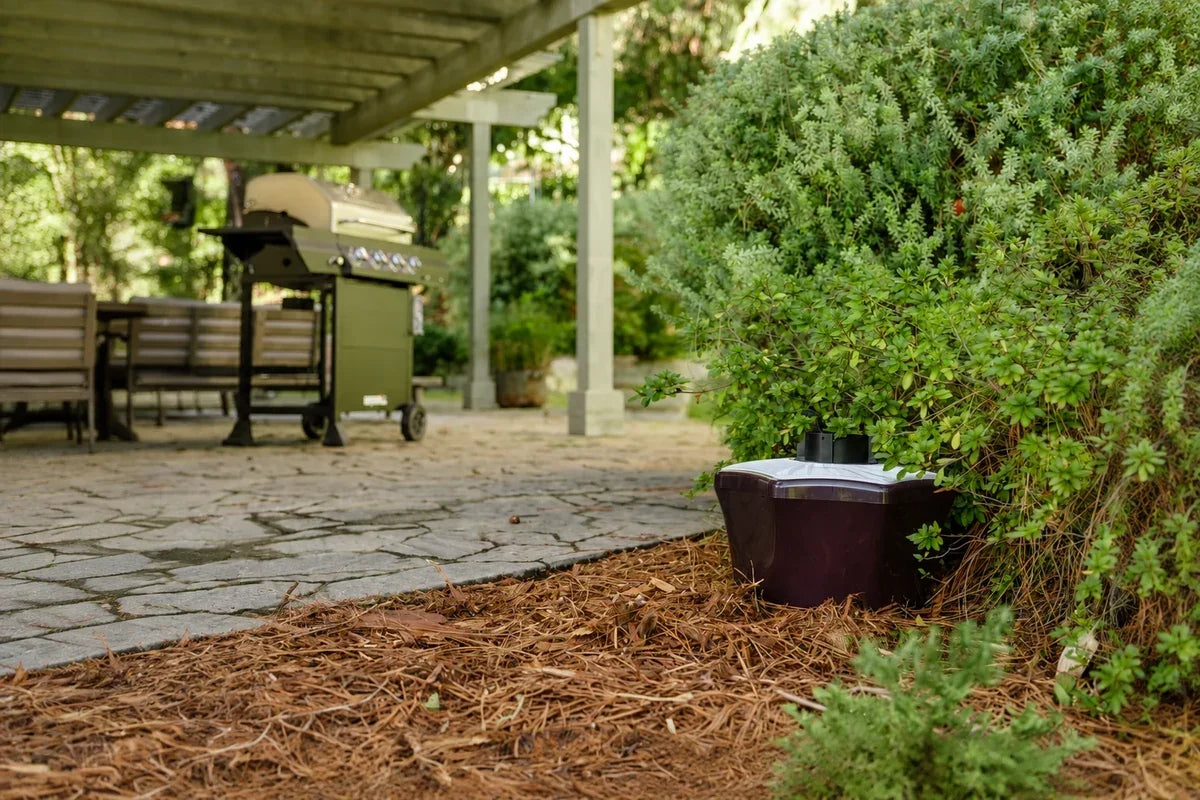
- Find where they're resting. Walk the yard in the middle of the day and look in the shaded, humid spots, under low bushes, along the fence line, behind the shed. That's where mosquitoes sit out the heat, so that's the best place to put a trap.
- Set the trap up properly. Whichever trap you're using, put it on level ground in one of those sheltered, shady spots, and keep it at least ten to fifteen feet from where you actually sit.
- Add the scent lure inside the trap. The attractant that goes inside copies the smell of human skin, which is what brings biting mosquitoes close enough to get caught.
- Add a GAT if you want to hit the next generation. A gravid trap does the opposite job to the Mosquitaire. Rather than imitating you, it imitates the still water that egg-laying mosquitoes look for after feeding, and catches them before they can lay.

Getting the Trap to Actually Catch Things
If a trap isn't catching much, it's usually the location rather than the trap. Mosquitoes avoid open sun and moving air, and those tend to be exactly the convenient spots, near the patio, by the back door, somewhere you'll remember to check it. Moving it a few yards into the shade often changes everything.
They're small enough to dry out fast, which is why they sit in damp shade through the day rather than out in the open. Put the trap in that kind of spot, low down and near planting. One thing people miss is sprinklers, so check where yours actually reach. A soaked catch net will stop the trap working properly, and water getting into the power connection is a hazard rather than an inconvenience.
This is the part that might seem backwards, and people get it wrong all the time. Don't put the trap next to where you sit. It works by imitating a person, using warmth, a high-contrast shape and the smell of skin, so sitting beside it means the mosquitoes have a real person and a fake one to choose between. They'll pick you, you'll get bitten, and the empty catch bag will make it look like the trap is useless. Put it well away from you, at least fifteen feet, and over toward the shaded planting they're coming from. The distance is what lets it pull them in before they reach you.

Leave it running continuously through the season, rather than switching it on for the evenings you're sitting outside. Different species hunt at different times, and tiger mosquitoes will bite you in the middle of the afternoon, while the dawn and dusk ones aren't sitting perfectly still the rest of the day either. A trap that's only on when you're out there is off for most of the hours something is looking for you.
Check the catch bag every week or two, depending on the season and how much you're catching. A trap on a small suburban lot in June fills up very differently from one on an acre of woodland edge in August. Empty it before it packs solid, because a full bag slows the airflow the trap depends on, and clear any leaves, cobwebs, or grass clippings out of the intake while you're there, since a blocked opening does the same thing.
Replace the attractant every two months. It works by giving off lactic acid and fatty acids, the same things your skin does, and it fades rather than stopping outright. People often don't notice, since the trap still looks and sounds like it's working normally.
If the catch is low but you're still getting bitten, move the trap. Five to ten yards deeper into the planting is usually enough, because mosquitoes stay where the air is damp and still, and a few yards can be the difference between the right conditions and the wrong ones. Give each new position a week before you judge it.
When you move it, check where the cord ends up. Keep the connection off the ground, clear of sprinklers and anywhere water collects, and plug it into a GFCI outlet, the kind with the test and reset buttons that cuts the power if water gets in. If you need an extension, use one rated for outdoor use rather than running a household cord out through a window.
If you're still working out which setup fits your yard, the full range of traps is laid out by what each one is for.

Frequently asked questions
Can Bti-Treated Water Be Used for Drinking?
Check the label, because it varies by product. Some Bti products are approved for water that animals drink from, and some aren't, and the label is the only place that tells you which you have. If it's a birdbath or a livestock trough, look for that approval specifically before you treat it.
Does a Natural Mosquito Trap Need Electricity?
A suction trap does, because the fan is what pulls mosquitoes in. That means an outdoor-rated cord and a GFCI outlet, and somewhere sensible to run the cable. If power is difficult where you'd want the trap, a GAT needs none at all, since it works by imitating still water rather than by suction. You'd pair that with emptying standing water, which costs nothing and doesn't need a socket.
Which Trap Should I Use for Biting Versus Egg-Laying Mosquitoes?
A Mosquitaire is the one for mosquitoes that are hunting you, since it imitates a person using warmth, a dark shape and the smell of skin. A GAT is for the ones that have already bitten someone and are looking for water to lay eggs in, so it imitates still water instead. Running both covers the mosquitoes biting you now and the ones that would be biting you in a few weeks.
What Should I Check When Captures Stay Low?
Work through it in order. Leave the trap in one position for a full week before you judge it, since a few quiet nights tell you nothing. Then check the obvious mechanical things, which are whether it's been running continuously, whether the intake is clear, and whether the attractant is older than two months. If all of that is fine, the problem is where it's standing, so move it further into the shade and away from wind and sun, and give the new spot another week.
Share:
Chigger vs Mosquito Bite: Clues, Care, and Prevention
Chigger vs Mosquito Bite: Clues, Care, and Prevention